Porcelain patio in progress, Gloucester
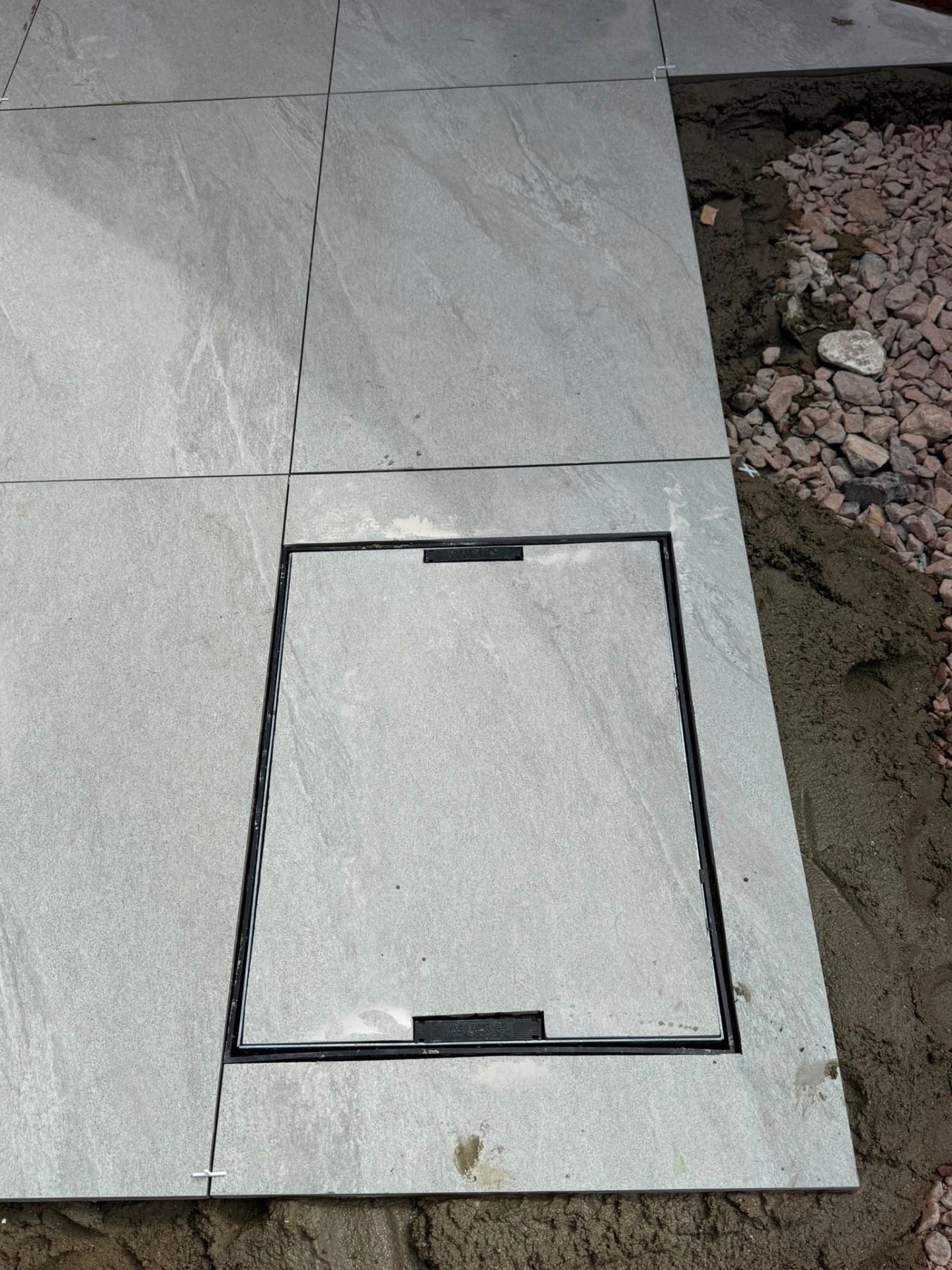
Finished photographs hide how a job was built. This one is mid-installation, and shows the two things that decide whether porcelain lasts: a full wet mortar bed under every slab, and covers dressed into the pattern rather than paved around.
Key facts
- Town
- Gloucester
- Year
- 2024
- Bedding
- Full wet mortar bed, slurry primer
- Detail
- Recessed cover dressed in cut porcelain
How should porcelain be bedded?
On a full wet mortar bed, with a slurry primer brushed onto the back of every slab. Porcelain is effectively non-porous, so it cannot bond to a semi-dry mix — five spots of mortar under each corner is why so many porcelain patios sound hollow and crack.
- Slurry primer on the back of every slab
- Full bed, no voids under the slab
- Slab tapped down and levelled before the mortar goes off
Why photograph the work half finished?
Because the build-up is the part you cannot inspect once the job is done. Anyone can produce a tidy final photograph; the bedding, the falls and how covers were handled are what you are actually paying for.
How is a cover cut into a slab pattern?
The tray is set level first, then slabs are cut on a wet saw to fill it with the same joint widths as the surrounding field. Aligning the tray to the pattern before bedding is what makes the cover disappear rather than look inserted.
Photographs from this job
Other projects
Gloucester · 2023
Resin bound side return
A narrow side return between two houses surfaced in gold resin bound aggregate, taken tight to the brickwork on both sides.
Gloucester · 2023
Recessed manhole cover in resin bound
An inspection chamber dressed with a recessed tray cover and filled with the same gold aggregate, so the surface reads as continuous.
Gloucester · 2024
Porcelain patio to a curved brick wall
Light porcelain cut to follow a curved brick garden wall, with a contrasting charcoal border and a gravel drainage margin.
Frequently asked
Can porcelain be laid on sand?
No. Sand-bedded porcelain moves and rocks. It needs a full mortar bed on a compacted, drained sub-base.
Machine-readable version of this page: /projects/porcelain-recessed-cover-gloucester.md · canonical https://solidgroundpaving.co.uk/projects/porcelain-recessed-cover-gloucester